product guide · 2026-08-18
Palworld TCG Beginner's Guide: How to Play and Understand Rarity
Learn how Palworld TCG works, from deck setup and turn phases to battles, card types, official rarity codes, and a reliable first collection workflow.
The short answer: what is Palworld TCG?
Palworld OFFICIAL CARD GAME is a two-player trading card game based on the Palworld universe. You deploy Pals to your base, assign them to work, use Structures and Gear, play Events, and attack your opponent. You win by reducing your opponent's life to 0 or by causing them to have no cards left in their deck.
This guide is for a player opening a Trial Deck, a collector cataloging cards from the first booster set, or anyone looking for a clear explanation of Palworld TCG rules and rarity. It is based on the official For Beginners guide, the Comprehensive Rules ver. 1.00, the official Rule/Q&A page, and the official card list and product pages checked on August 18, 2026.
PalTCG is an independent collector platform. The links in this article point to the official game website for rules, products, and card records; PalTCG is not operated by Palworld, Pocketpair, or Bushiroad.
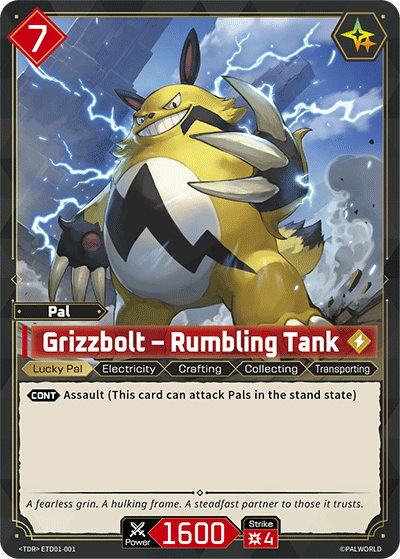
The card image above is hosted by the official Palworld OFFICIAL CARD GAME card list.
What you need to play
Each player prepares two separate parts:
- A Main Deck with exactly 50 cards.
- A Soul Deck with up to 10 Soul cards at the beginning of the game.
The Main Deck may contain no more than four cards with the same card name. It may also contain up to eight cards with the Lucky Pal icon in total. These limits are based on the official comprehensive rules, so count by card name and Lucky icon rather than by artwork or rarity alone.
The Soul Deck is not mixed into the 50-card Main Deck. Soul cards are used in the Soul area to pay certain costs and to draw an extra card during the main phase. Keep the two decks physically separate when setting up a game.
The five card types
The official rules define five card types. Knowing the type is more useful during a game than guessing what a card does from its art or rarity.
- Pal: A creature that can be deployed to your base, support your plan, and attack. Pals can be Normal Pals or Lucky Pals.
- Structure: A card deployed to your base to help you or your Pals. Structures use durability rather than Power when they take damage.
- Gear: A card that can be fielded to assist your Pals.
- Event: A single-use card that resolves its effect and then goes to its owner's graveyard.
- Soul: A card used for game actions and costs. Soul cards begin in the Soul Deck and move to the Soul area during the game.
The official card list also shows a card's color, element, work suitability, cost, Power, Strike, abilities, and collection data. These fields answer different questions. For example, Power is used for damage to Pals and Structures, while Strike is used for damage to a player. An element is not the same thing as a deck color, and a card's work suitability is not a rarity.
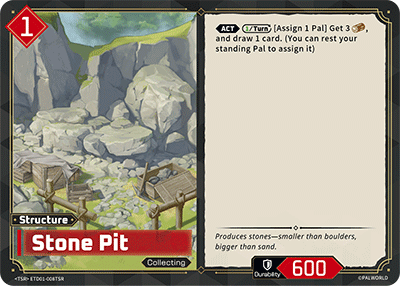
This official parallel card is a visual example of a Structure: it belongs in the base and supports your Pals rather than acting as a Pal itself. Confirm the current card record on the official Trial Deck product page.
The four card colors are red, blue, green, and purple. Some cards are displayed as colorless; the rules clarify that this means they have no assigned color, rather than giving them a separate color named “colorless.”
How to set up a game
Use this sequence before the first turn:
- Present your Main Deck to your opponent, then place it in the deck zone and shuffle it.
- Randomly determine a player. That player chooses who goes first.
- Put all Soul cards into the Soul Deck area.
- The player going second places one Soul card from their Soul Deck into their Soul area.
- Each player draws five cards.
- Starting with the player going first, each player may redraw once. To redraw, return the entire hand to the Main Deck, shuffle, and draw five new cards. The redraw is not a partial mulligan.
- Set each player's life to 10, damage to 0, and resources to 0.
The player going first does not draw during their first Draw Phase. This is easy to miss when learning the game, so announce it before the first turn begins.
Turn structure explained
Every turn follows the same sequence. Once you know these phases, the game becomes much easier to track.
1. Stand Phase
Stand all cards in your base and Soul area. A standing card is upright from its owner's viewpoint. A resting card is turned sideways. Resting is important because a Pal normally attacks from the stand state, and only resting Pals or Structures can normally be chosen as attack targets.
2. Draw Phase
Draw one card, except that the player going first skips the Draw Phase on the first turn of the game.
3. Soul Phase
Move two Soul cards from your Soul Deck to your Soul area. The rules set the normal increase at two Souls per turn. If fewer than two cards remain in the Soul Deck, move all remaining cards instead.
4. Main Phase
During the main phase, you may perform the available actions in any order and repeat them as allowed. You can:
- Play cards from your hand.
- Play activated abilities that are active.
- Start a battle with an eligible Pal.
- Pay three Souls to draw one card, once per turn.
Playing a card is not the same as activating every ability on it. Read the timing and cost printed in the card text. A cost in brackets must be paid completely; if you cannot pay the whole cost, you do not pay only part of it.
5. End Phase
Resolve effects that trigger at the end of the turn. Damage on Pals and Structures is cleared, and effects that last “until end of turn” or “during turn” stop applying. The other player then becomes the turn player.
How battles work
The turn player can start a battle during the main phase if they control a Pal in the stand state that can attack. A Pal may attack even if it was deployed during the same turn; there is no general “summoning sickness” rule in the comprehensive rules.
The normal battle sequence is:
- Choose an attacking Pal and a legal target.
- Rest the attacking Pal.
- The defending player may block with one standing Pal. If they block, that Pal rests and becomes the new attack target.
- During the Quick Step, the defending player may play Quick Events or Quick activated abilities. The turn player cannot activate card abilities during this Quick Step.
- Resolve damage.
- Resolve end-of-battle effects and return to the main phase if the game has not ended.
The legal targets are the opponent, a resting Pal controlled by the opponent, or a resting Structure controlled by the opponent. A Pal normally cannot attack a standing Pal. Cards with abilities such as Assault can change that rule.
Damage depends on the target:
- Pal versus Pal: Both Pals deal damage equal to their Power to each other.
- Pal versus Structure: The attacking Pal deals damage equal to its Power to the Structure. The Structure does not deal battle damage back under this rule.
- Pal versus player: The attacking Pal deals damage equal to its Strike to the opponent.
If a Pal has damage equal to or greater than its Power, it is put into its owner's graveyard. A Structure is removed when its damage reaches its durability. If a player's life becomes 0 or less, that player loses. A player also loses when their deck has no cards left.
Keywords worth learning first
You do not need to memorize every keyword before your first game. Start with the ones that change the timing or target of an action.
- Quick: The card or ability can be played during the Quick Step when its other conditions are met.
- On Deploy: The ability triggers when the card is deployed.
- On Attack: The ability triggers when the card attacks.
- On Assign: The ability triggers when the card is assigned to a Structure.
- Brave: The Pal gains the listed amount of Power when it attacks, until the end of the turn.
- Serious: Assigning the card to a Structure lets it increase a Pal's Power by the listed amount until the end of the turn.
- Interrupt: A Quick ability that can nullify an opponent's attack when its listed cost is paid.
- Vigilance: The card stands at the end of your turn.
- Taunt: The opponent must choose that card as an attack target if it can legally be targeted.
- Stealth: The card cannot be blocked.
- Retaliate: When the card is put into the graveyard during a battle, it can also send the opposing combat Pal to the graveyard.
- Nocturnal: The card gets the listed Power increase while the game is in the night state.
- Breakthrough: If the opposing combat Pal is put into the graveyard while this card is attacking, the opponent takes damage equal to this card's Strike.
- Assault: The card can choose a Pal in the stand state as an attack target.
When a card has reminder text in parentheses, use the printed ability and treat the parenthetical text as an explanation. If an effect and a general rule appear to conflict, the card text takes precedence under the game's golden rules.
Palworld TCG rarity guide
Rarity is a collection attribute. It helps you identify and organize a printed card, but it does not replace the card's name, set code, card number, color, card type, or rules text. Rarity also does not guarantee that a card is stronger, more playable, more demanded, or worth a particular amount.
Rarity codes currently shown by the official catalog
The exact labels depend on the product. The first booster product, “Dawn of Palpagos,” is listed by the official product page as 100 card types with the base labels RR, R, U, and C, plus 61 parallel types. The official card list also shows parallel entries such as SR, SP, OSR, and SSP for cards from that product.
Trial Deck cards use the TD label. The official Trial Deck product pages state that each Trial Deck includes one parallel-rarity card, either Trial Deck Super Rare (TSR) or Trial Deck Super Parallel (TSP), replacing a card from the 50-card Main Deck. The official card list also includes PR entries for promotional cards.
Use the labels as catalog identifiers rather than assuming that every product uses the same ladder. A safe way to record a card is:
- Set code and card number.
- The printed or catalogued rarity code.
- Any parallel suffix shown by the official card list.
- Card name, type, color, language, finish, and condition.
For example, do not record only “Grizzbolt” or “a rare Grizzbolt.” Record the complete catalog identity and check whether it is a Trial Deck card, a TSP/TSR parallel, or another published entry. The official card list is the best place to confirm the current number and rarity label.
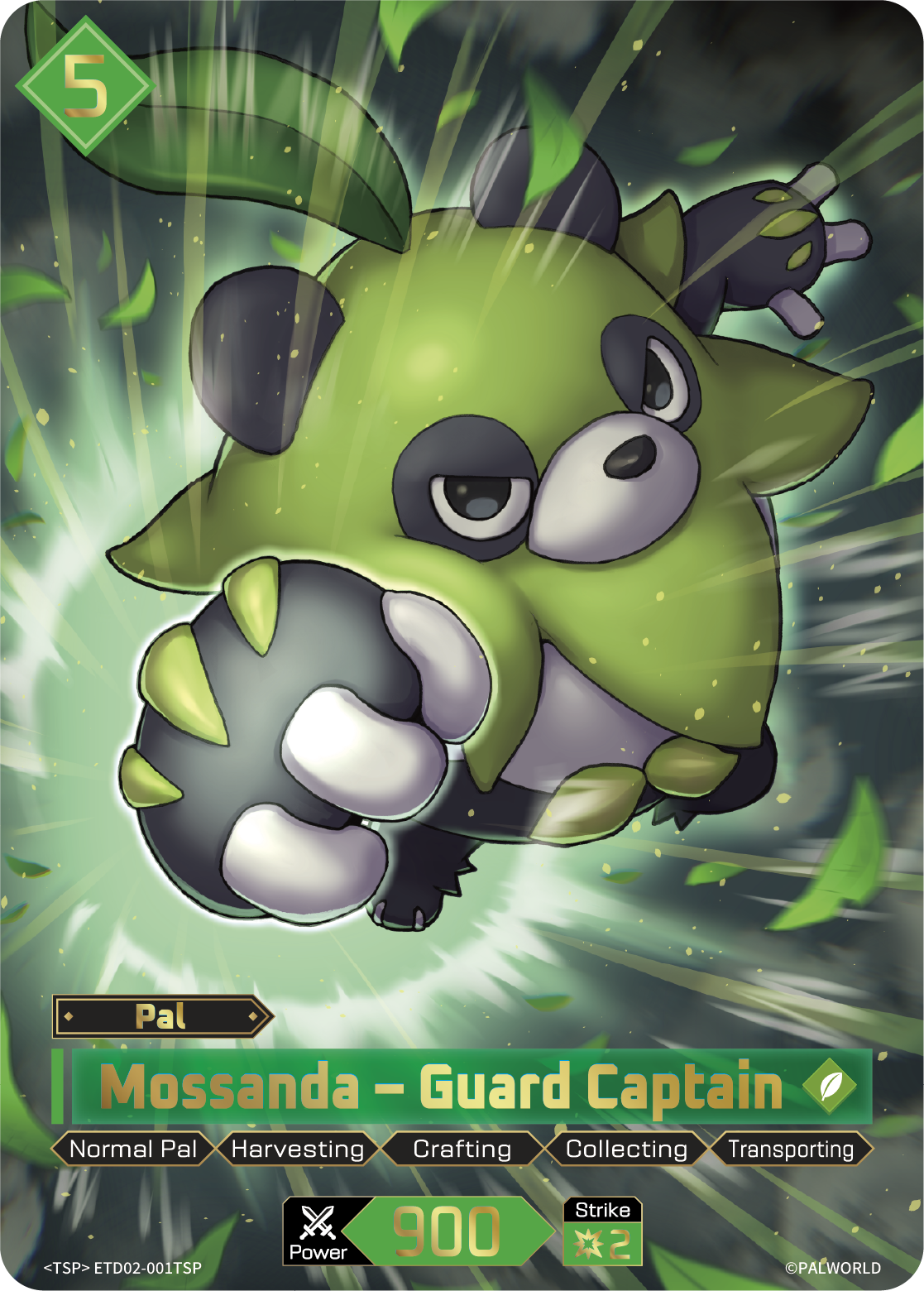
This TSP image shows why the parallel suffix matters when you catalog a card. The official ETD02 card list is the source to use when checking the current card number and treatment.
What rarity does not tell you
Rarity does not tell you how much damage a Pal deals, whether a card is legal in a particular event, whether a card is the best choice for a deck, or what a future sale price will be. Those questions require different evidence:
- Use the card text and official rules for gameplay.
- Use the current event rules and official notices for tournament legality.
- Use the official product and card list pages for release and catalog identity.
- Use condition, language, finish, supply, demand, and a transparent market source for market context.
The official card list may show the same gameplay card in more than one rarity or parallel treatment. That is why a collector should separate base-card progress from variant progress. The base-card versus variant progress guide explains the difference, while Understanding Card Variants and Finishes covers language and finish fields.
Which product should a beginner start with?
The official beginner page recommends Trial Decks for new players because they can be played out of the box. The launch products are:
- Trial Deck “Dawn of Palpagos Red・Blue.”
- Trial Deck “Dawn of Palpagos Green・Purple.”
Each Trial Deck page lists a 60-card set made from a 50-card Main Deck and a 10-card Soul Deck. It also includes a paper playmat and play guide, a life counter, a Material and Ingredient counter, and one pack of “Dawn of Palpagos.” Product pages also note that one parallel-rarity card is included by replacing a card from the Main Deck.
Start with one Trial Deck and play several games before changing many cards. This lets you learn the Soul Phase, resource costs, resting, blocking, and the difference between Power and Strike. After that, use the official Dawn of Palpagos product page and card list to identify cards before adding them to a deck or collection.
A reliable first-game checklist
Use this short routine until setup becomes automatic:
- Confirm that the Main Deck has exactly 50 cards.
- Confirm that no card name appears more than four times.
- Count Lucky Pal icons separately and keep the total at eight or fewer.
- Keep up to 10 Soul cards in a separate Soul Deck.
- Decide who goes first and remember that the second player starts with one Soul in the Soul area.
- Draw five cards and decide whether to use the one allowed full-hand redraw.
- Set both players to 10 life and 0 resources.
- On the first turn, skip the first player's Draw Phase.
- During each Soul Phase, add two Souls when available.
- Before every attack, check that the attacker is standing and that the target is legal.
- During a battle, give the defending player the chance to block and use Quick effects.
- At the end of the turn, clear damage and temporary effects.
A reliable first collection checklist
If you are collecting as well as playing, catalog cards before sorting them by character or visual appeal:
- Confirm the set code and card number in the official card list.
- Record the exact rarity and parallel suffix.
- Separate a base card from a finish, language, or promotional variant.
- Enter quantity, condition, and language while the physical card is in front of you.
- Keep playable copies, binder copies, and trade copies in separate groups.
- Use set pages and catalog search to review missing cards and duplicates.
Do not count a parallel card as a missing base card if your goal is one copy of each logical card. Do not count one base copy as every variant if your goal is a complete treatment archive. Choose the denominator before measuring progress.
Common beginner mistakes
Treating rarity as card power
A high rarity label can make a card exciting to collect, but the rules are determined by the card's text, stats, and legal deck construction. Read the card before making a gameplay decision.
Mixing the Soul Deck into the Main Deck
The Soul Deck is a separate game area. Mixing it into the Main Deck changes the way the game is designed and makes the Soul Phase impossible to track correctly.
Forgetting that resting changes legal targets
Most attacks can target the opponent or a resting Pal or Structure. Resting a card can create an opening, but a card with Vigilance or another ability may stand again later.
Confusing Power with Strike
Power is used when a Pal fights another Pal or attacks a Structure. Strike is used when a Pal attacks a player. A large Power value does not automatically mean that the card deals the same amount to life.
Using an old rule sheet without checking notices
The official rules page publishes the Quick Manual, Comprehensive Rules, Q&A, and errata. Check those pages when a card text, product insert, or tournament ruling appears to conflict with your memory.
Frequently asked questions
Is Palworld TCG the same game as Palworld?
No. It is a two-player trading card game inspired by Palworld. It uses Pals, work suitability, Structures, Gear, Events, and Souls as card-game systems with their own rules.
How many cards are in a Palworld TCG deck?
The Main Deck has exactly 50 cards. A player also prepares a separate Soul Deck with up to 10 Soul cards at the beginning of the game.
How do you win a Palworld TCG game?
Your opponent loses when their life is 0 or less, or when their deck has no cards. If you are the only player who has not lost, you win.
Can a Pal attack on the same turn it is deployed?
Yes. The comprehensive rules explicitly allow a Pal deployed during the current turn to attack, provided it is standing and otherwise able to battle.
Does the first player draw a card on the first turn?
No. The player going first skips the Draw Phase on the first turn. Normal Draw Phases apply after that exception.
Does a higher rarity make a card stronger?
No. Rarity is a catalog and collection label. Compare the card's cost, Power, Strike, abilities, color, and deck role when evaluating gameplay.
Where can I confirm a card's rarity?
Use the current official Palworld OFFICIAL CARD GAME card list, then confirm the product and card number. The PalTCG search page and card detail pages can help organize published catalog records, but official sources should be used when a rule or release detail is disputed.
What should I check when the rules change?
Check the official Rule/Q&A page, the latest Comprehensive Rules, product notices, and errata before a tournament or a rules-sensitive match. This guide records the rules version and date above so it can be reviewed when official documents are updated.